Ghost Troop sequence of events
CRP destroyed at the 55 Easting
Ghost Troop destroys the combat reconnaissance patrol of the Tawakalna Division, Republican Guard. Weather begins to deteriorate.
Ordered forward to the 70 Easting
The troop moves east in a worsening sandstorm. Visibility falls until only thermal hot spots are visible forward of positions.
White Platoon destroys an MRR company
At the 65 Easting, White Platoon identifies vehicles through the storm. The troop follows the platoon leader’s tank into a motorized rifle regiment company — the forward security element of the Tawakalna Division — and destroys it as the troop consolidates on the 67 Easting.
The 73 Easting fight
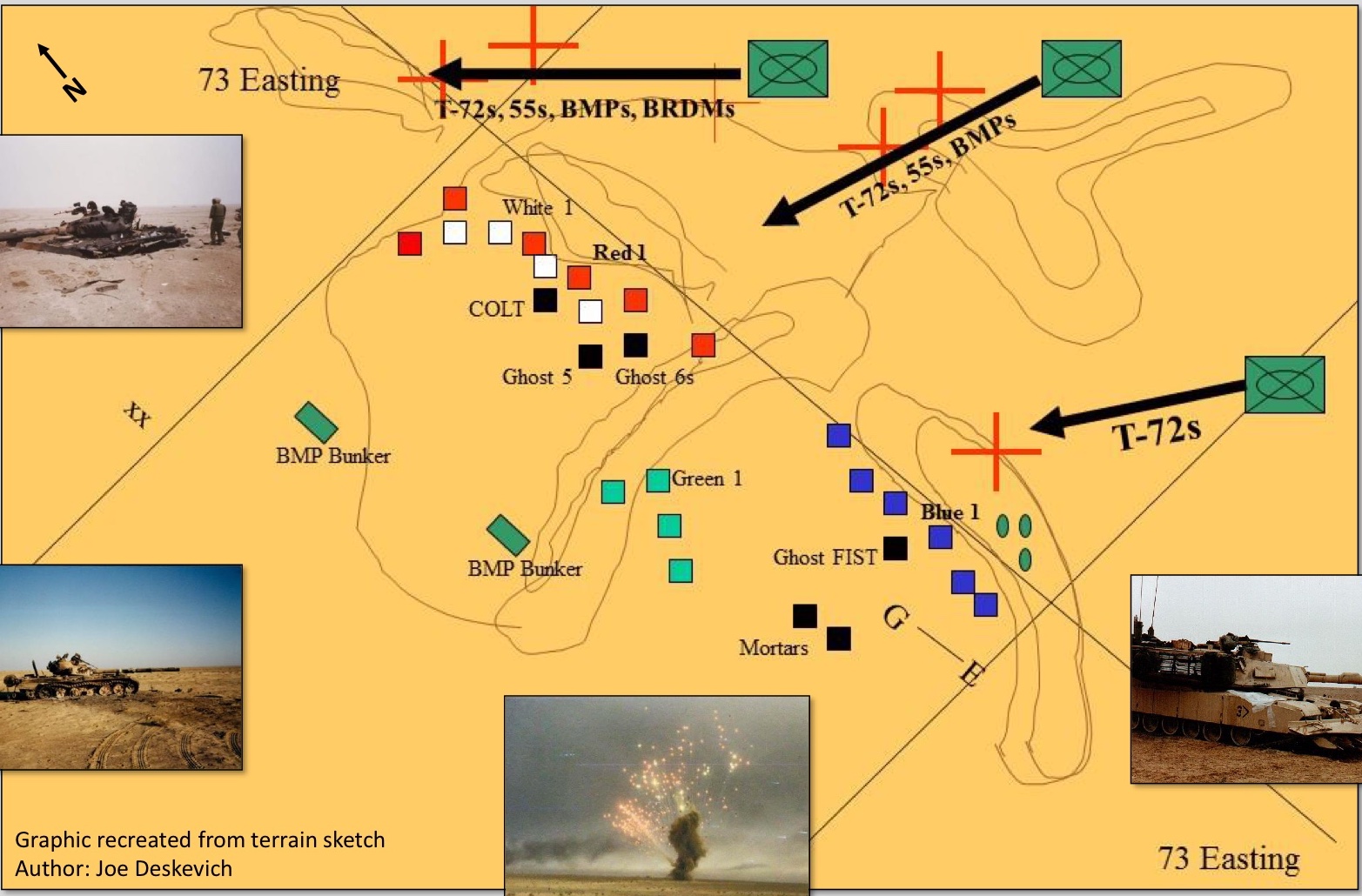
Ghost Troop comes on line at the 73 Easting as Eagle Troop’s fight ends. Red and White platoons in the north engage T-72s, BMP-1s, BRDMs, and T-55s. Ghost Troop is given priority of fires for all of VII Corps. The platoon engagement described below occurs within this fight.
The platoon engagement
In the worsening storm, White Platoon’s thermal sights picked out vehicles through smoke and blowing sand that the naked eye could not. The platoon leader requested to push forward of the burning plumes to clear his sector. What lay beyond was a Republican Guard mechanized company strongpoint — dug-in armor with supporting infantry.
The platoon’s four tanks closed on the position and achieved total surprise, destroying approximately twelve armored vehicles. At under twenty meters, Iraqi infantry surged from trenches with rocket-propelled grenades. A BMP’s 73mm round passed close enough to be felt. Kilgore fought from the open hatch on the .50 caliber machine gun at fifteen meters, exposed above the armor, until every weapon on the tank was exhausted — down to his M1911 pistol.
He ordered an emergency reverse under fire, re-formed the platoon’s line at roughly one hundred meters, and directed the destruction of the remaining enemy in about sixty seconds.
Of Ghost Troop’s nine tanks, only the troop commander’s and 2nd Platoon’s four fired main gun that day. The engagement above accounts for most of the troop’s twenty-one confirmed main gun rounds.
Intensity of action: rounds fired, 26 February 1991
In Ghost Troop, only the troop commander’s tank and 2nd Platoon’s tanks fired main gun rounds. Figures confirmed or estimated at the time by the support platoon leader, executive officers, and commanders; the DARPA/CMH reconstruction recorded fewer tank rounds (82 Eagle, 21 Ghost) and no artillery data.
| Weapon system | Eagle Troop | Ghost Troop | Howitzer Battery |
|---|---|---|---|
| Tank main gun (all munitions) | 97 confirmed | 21 confirmed | — |
| TOW missiles | 24 confirmed | 30 confirmed | — |
| 25mm (all munitions) | 4,100 est. | 894 confirmed | — |
| .50 caliber machine gun | 400 est. | 730 est. | — |
| 7.62 machine gun | 150 est. | 765 est. | — |
| 4.2-inch mortar (all munitions) | 60 confirmed | 248 confirmed | — |
| 155mm artillery (all munitions) | — | — | 1,100 rounds |
An open question the record must resolve
Published accounts differ on whether the switch to the platoon radio net during the close assault was deliberate or accidental — a knee on the junction box. The witness statement form asks every contributor this question directly, so the packet reconciles the discrepancy before a board encounters it.